Three changes in one week
I do not normally write news articles. When I do, it is because something happened that concretely changes your work — not because a company sent out a press release.
This week that happened three times:
- 20 July: The rules for which Claude model sits in which subscription were resorted. If you are a paying customer, this affects you directly.
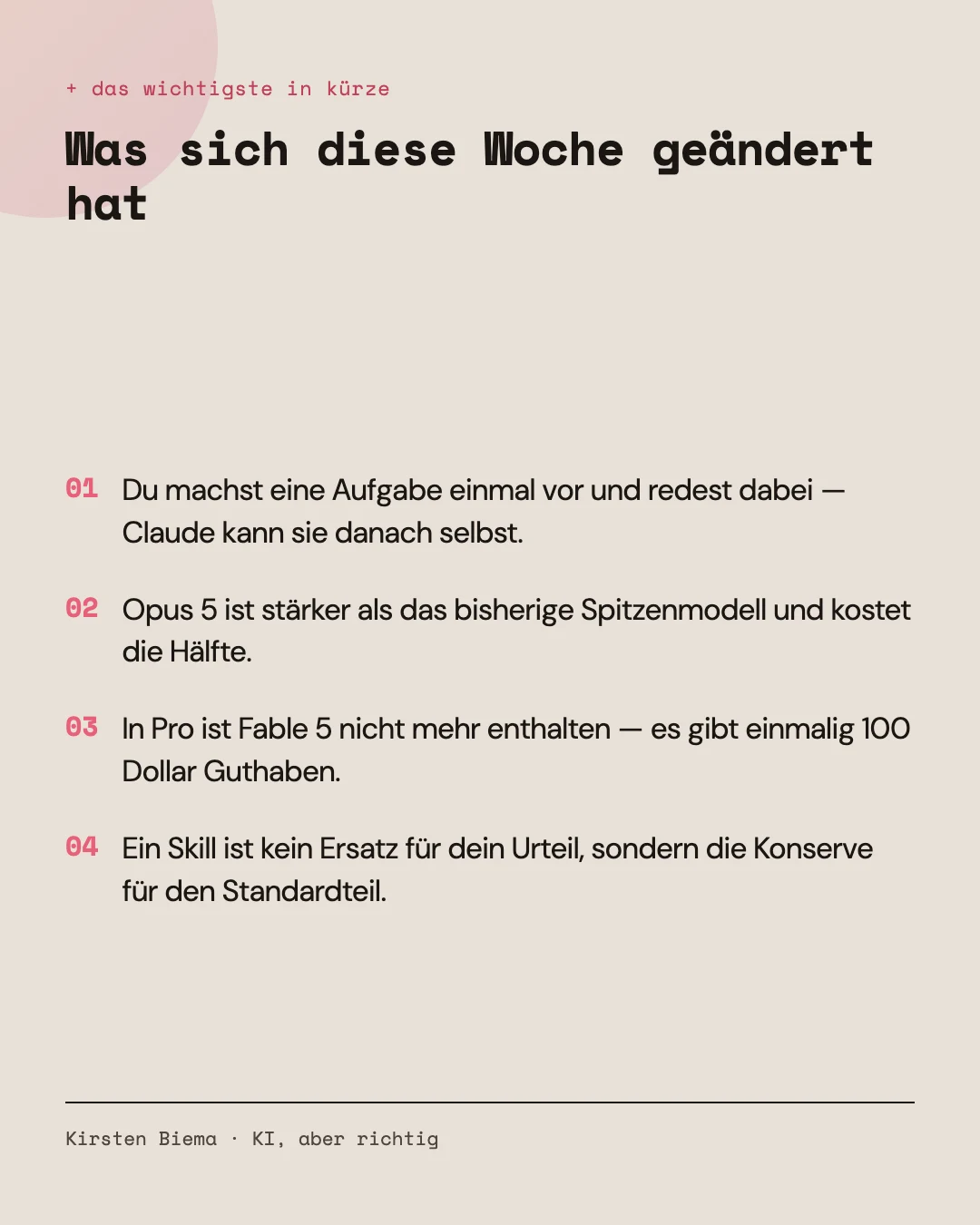
- 21 July: Claude can now take over a task after you have demonstrated it once — by screen recording.
- 24 July: A new model called Opus 5 appeared.
I will go through them in the order that counts for your business — not the order they appeared in.
The most important first: you show it once, Claude can then do it
The feature is called “Record a Skill” and sits in the Cowork area of the Claude app on the computer. The principle is so simple it almost sounds unspectacular:
- You start the recording via the plus menu.
- You do your task completely normally — clicking, typing, working.
- You explain out loud as you go what you are doing and why you do it that way.
- You stop the recording.
Claude evaluates what you did — your clicks, your inputs, your spoken explanations — and turns it into a Skill: a capability that is stored in your library and that you can call up any time from then on, without repeating the explanation.
Why this is a bigger step than it sounds
Until now there were two ways to hand Claude a recurring task: you wrote a very precise prompt, or you created a skill in text form. Both work — but both require you to first translate your own work into words.
And that is exactly where most people fail. Not because they lack ability, but because they no longer consciously perceive their own routines. Ask an entrepreneur how she does her monthly review and you get “well, I just look at the numbers”. Sit down next to her and watch, and you see fourteen individual steps.
Demonstrating is easier than describing. That is the whole point. You no longer have to translate your process into a manual — you simply do it, as always, and talk while you do.
For you as a non-techie this means: the last real hurdle between “I know how this works” and “the AI now does this for me” has just become considerably smaller.
What you need for it
- The Claude app on the computer — the feature does not exist in the browser or on the phone.
- A Pro, Max or Team subscription. It is not included in the free tier.
- A task you do regularly and that always runs the same way.
What it pays off for — and what not
Well suited are routines that are always the same and occur repeatedly: sorting and filing invoices, transferring numbers from a portal into a spreadsheet, answering enquiries along a fixed pattern, compiling recurring reports.
Not suited is everything that runs differently every time or where you decide anew on each pass. A skill is no substitute for your judgement — it is the preserved version of the part where you no longer decide anything anyway.
That, incidentally, is the same distinction my whole approach revolves around: Which processes in your business are standard, and what do only you decide? Anyone who has not answered this question only automates their chaos — with screen recording just as much as without.
Second: check what your subscription still includes
This change is unspectacular, but it costs money — which is why it comes before the new model.
Since 20 July, the following applies to Fable 5, until then the most powerful model:
- Max and Team Premium: Fable 5 remains included — but only with halved usage limits.
- Pro and Team Standard: Fable 5 is no longer included in the subscription. You receive a one-off credit of 100 US dollars. Once that is used up, you pay per use — at the prices otherwise only developers pay.
Let me say this clearly, because I have already heard it wrong: The 100 dollars are a gift, not a bill. It is a one-off starting credit, not a new subscription price.
I am not affected by this myself, but close to it: I use Fable 5 very intensively, and in my Max subscription it remains included. If I had Pro, this would be a noticeable restriction for me — which is exactly why I am writing about it.
What you should do now: Check which subscription you have and which model you actually use. If you have Pro and were relying on Fable 5, your subscription has just quietly become worth less. That is annoying — but there is good news, and it comes now.
Third: Claude Opus 5 — more performance for less money
On 24 July 2026, Claude Opus 5 appeared. Three things about it are remarkable:
It is stronger than the previous flagship model. In the maker’s tests, Opus 5 beats the more expensive Fable 5 on several programming and knowledge-work tasks — on a benchmark for particularly hard reasoning tasks it scored 43.3 percent against 33.7 percent. That is unusual: normally the most expensive model is also the strongest.
And it costs half. Compared with Fable 5, the cost per amount of text processed is halved — with better results in many areas.
It remembers more in one go. Opus 5 works with a text window of one million tokens. In practice that means: you can give it very extensive documents — entire manuals, long evaluations, complete project histories — without it forgetting the beginning.
On top comes a setting that did not exist like this before: you can control how thoroughly Claude should think. A low level for quick routine questions, the highest for hard decisions. It sounds technical but is simple in everyday use — more thinking costs more time and money, less is faster. You decide what the task is worth.
How the Claude models differ in principle and which is meant for what, I have broken down in Claude Fable 5 vs. Opus — the framework there still applies; Opus 5 simply takes the top spot among the everyday models.
And because I dislike writing about things I have not used myself: I have been testing Opus 5 for twenty-four hours, and the output is genuinely good. That is not a long-term verdict yet — it is too early for that, and I will tell you more in a few weeks. But the first impression matches what the maker claims, and that is not a given.
What this means for you: Opus 5 is from now on the default model in Max and the strongest option you get in Pro. Anyone who has just lost access to Fable 5 receives, in the same breath, a model that is in many cases the better choice — and that remains included in the subscription.
Bottom line: for the vast majority of solopreneurs this is not a loss but a trade where you come out ahead. You do not have to change anything for it — in Max, Opus 5 runs automatically; in Pro you select it in the model menu. What you can then build with the recorded skills is shown in Building an AI agent.
What I make of it
Of the three changes, one really matters, and it is not the new model.
Models get better every few weeks. That is background noise by now — you notice it in your results getting better without you doing anything. It is not a decision you have to make.
The screen recording is a decision. It changes who can hand a task over to AI. Until now you needed the ability to describe your work cleanly — an ability much rarer than everyone pretends. Now it is enough to demonstrate it once and talk while you do.
I think this feature is terrific, and not because it is technically impressive. But because it tears down exactly the hurdle I have watched solopreneurs fail at for years: they can do their work — they just cannot write it down. That translation work now disappears.
What does not change because of it: you still decide what gets handed over in the first place. A recording of a bad process yields a bad skill — just faster. Structure before tool, as always.
How to handle it — in three steps
- Check your subscription. Which one do you have, which model do you actually use? Five minutes, and you know whether the change of 20 July affects you at all.
- Pick a single task. Not the most complicated one — the most boring one. Something you do every week and where you no longer decide anything.
- Record it once. Talk while you do, as if you were showing it to a new colleague. Afterwards you will know more about the practical value of this feature than from any article — including this one.
If you get stuck at step 2 and do not know which of your routines are actually standard: that is exactly what I built the location check for. A few minutes, honest questions, and you know where you stand and what your next step is.
Skills only pay off once you tailor them to your own routines — and for that it helps to see how others do it. That is exactly what we talk about in my free community “KI — aber richtig” — the templates and workflows from my videos live there too. And if you want company instead of doing it alone: the AI Business Community (in German) offers monthly live calls and workshops for exactly that.
Frequently asked questions
What is a skill in Claude?
A skill is a stored capability: a routine you hand to Claude once and can then call up again at any time without explaining it anew. Until now you created skills in text form — since 21 July you can also record them, by demonstrating the task on screen while explaining out loud.
How does “Record a Skill” work in Claude Cowork?
You start the recording in the plus menu of the Claude app on your computer, do your task as usual and say out loud what you are doing and why. After stopping, Claude evaluates clicks, inputs and your explanations and creates a skill from them in your library.
Do I need a paid subscription for this?
Yes. The feature is included in the Pro, Max and Team subscriptions and runs exclusively in the Claude app on the computer — not in the browser and not on the phone.
Is Fable 5 still included in my Claude subscription?
That depends on the subscription. In Max and Team Premium, Fable 5 remains included, though with halved usage limits. In Pro and Team Standard it is no longer included — there you get a one-off credit of 100 US dollars, after which you pay per use.
What is Claude Opus 5?
Claude Opus 5 is the model Anthropic released on 24 July 2026. In the maker’s tests it beats the more expensive Fable 5 on several programming and knowledge-work tasks while costing only half. It works with a text window of one million tokens and lets you control how thoroughly it thinks. In Max it is the default model, in Pro the strongest available option.
Is Claude Opus 5 better than Fable 5?
In several of the maker’s tests, yes — on programming and knowledge tasks Opus 5 leads, and on a benchmark for hard reasoning tasks it scored 43.3 against 33.7 percent. Fable 5 remains the top for certain very long, complex tasks but costs twice as much. For the everyday work of most self-employed people, Opus 5 is the more sensible choice, if only because it remains included in the subscription.
What does Claude Opus 5 cost?
In the subscription it costs nothing extra: in Max it is the default model, in Pro selectable. Only those billing via the API pay per use — there, Opus 5 sits at half of what Fable 5 costs. An overview of the Claude plans with my recommendation is in What does Claude cost?
Do I have to change anything to use Opus 5?
Not in Max — there it is already the default model. In Pro you select it once in the model menu. Your existing projects, skills and conversations keep working unchanged.
Does a screen recording replace my processes?
No. It transfers a routine you already have. If that routine is unclear or needlessly complicated, the recording does not make it better — only faster to repeat. Taking stock of your processes remains the first step.